


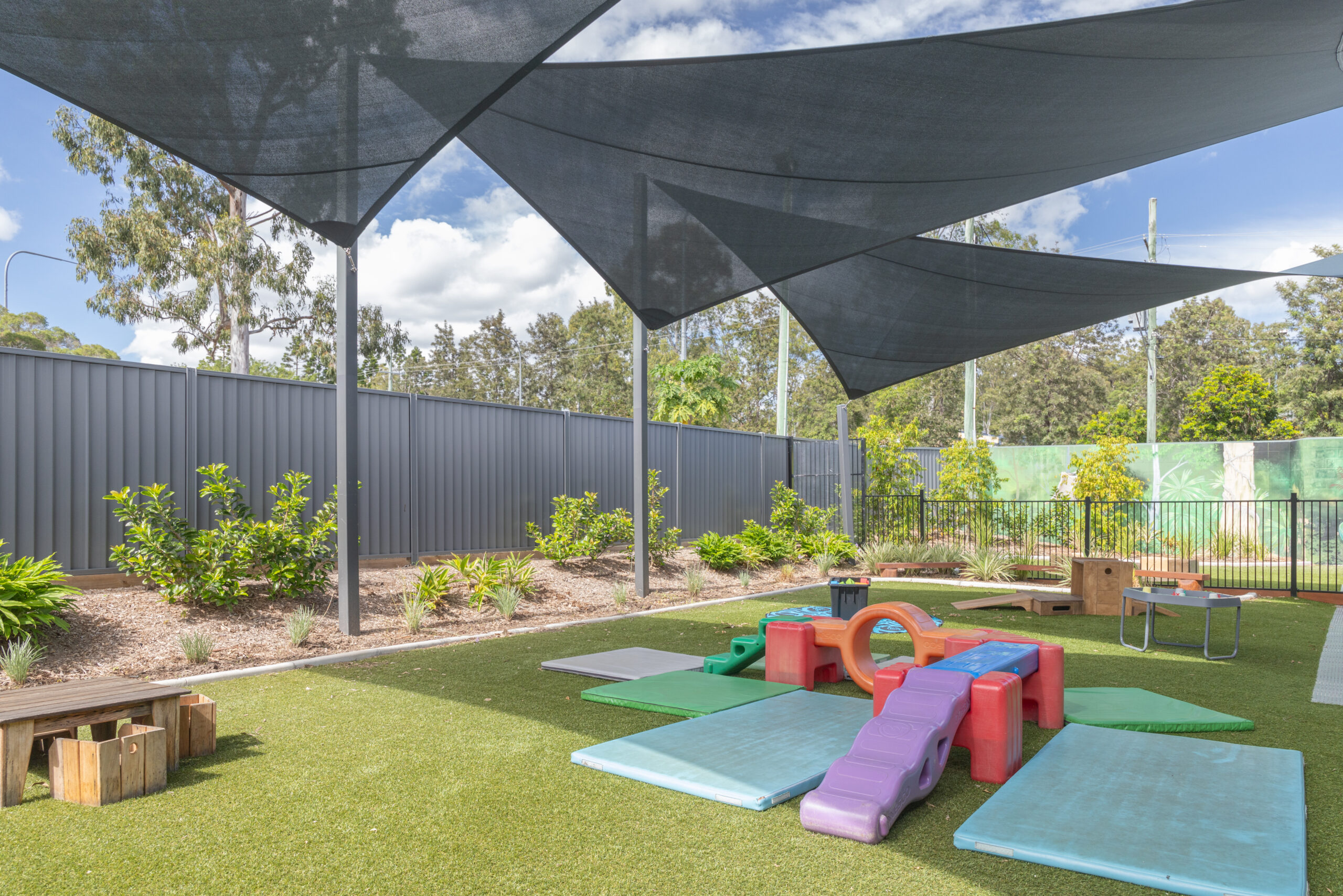

There's a moment most parents experience in the car on the way home from childcare. You ask your child what they did today. They say "nothing" or "played." And you're left wondering, but what were they actually doing in there?
The answer, almost always, is learning. Just not in the way we tend to picture it. There are no worksheets, no desks, no hand-raising. What early childhood learning looks like, really looks like, is a baby mouthing a wooden block, a toddler in a cape insisting she's a vet, a preschooler asking seventeen questions about where worms go when it rains. It is messy and joyful and purposeful, even when it doesn't look like it from the outside.
Here's what's actually happening at each stage.
Babies (0-12 months): Learning through the senses
In the first year of life, every single experience is new information. Babies learn by touching, tasting, listening, watching, and being held. This is not passive. It is some of the most intense cognitive work a human brain will ever do.
When a baby reaches for a rattle and misses, then reaches again and grasps it, that's problem-solving. When they startle at a loud sound and then look to their educator's face to read whether it's safe, that's emotional regulation in its earliest form. When they babble and an educator babbles back, matching their rhythm and expression, that's the very beginning of language.
What educators at Milestones are doing in the baby room isn't just caring for infants. They're responding. They're narrating, "I'm going to pick you up now, here we go", because language-rich environments in the first year build the neural pathways that support reading years later. They're setting up environments with texture, contrast, and gentle challenge, because even the youngest children learn best when they're gently curious, not overwhelmed.
At home, you're doing this too every time you talk through a nappy change, make faces across the table, or let your baby squish their first bit of banana.
Toddlers (1-3 years): Learning through play, movement and pretend
Toddlers are famously busy. What looks like chaos, the running, the dumping, the dramatic crying, the sudden obsession with one particular red cup, is actually a child working very hard to understand how the world works.
Symbolic play is the hallmark of this stage. When a toddler picks up a stick and calls it a phone, or feeds a stuffed elephant imaginary soup, they're developing abstract thinking, the cognitive leap that underpins language, maths, and creativity. When they fill and empty a bucket at the water table, they're building early concepts of volume and cause and effect. When they argue over a truck with another child and a patient educator helps them navigate it, they're learning negotiation, empathy, and self-regulation.
At this age, movement and learning are completely inseparable. Running, climbing, dancing, pushing a trolley, all of it builds the gross motor skills, spatial awareness, and physical confidence that children need for everything that comes next.
Try this at home: give your toddler a cardboard box, a wooden spoon, and ten minutes with no instructions. Watch what they make of it.
Preschoolers (3-5 years): Learning through inquiry, connection and big ideas
By the time children reach preschool age, they are ready, genuinely ready, to explore ideas in depth. This is when the questions start. Why do leaves fall? Where does the sun go? What happens if we mix these two colours?
Good early childhood educators don't answer these questions straight away. They turn them back. They write the question on a piece of paper and stick it to the wall. They gather the children around a magnifying glass and say, "let's find out." This is inquiry-based learning, and it's one of the most powerful things that happens in a quality preschool room.
Projects at this age might unfold over days or even weeks. A group of children becomes fascinated with spiders. Educators bring in books, create provocations with webs made of string, invite children to draw what they notice, ask families to share spider sightings from home. By the end, those children haven't just learned about spiders, they've practised observation, recording, discussion, collaboration, and sustained attention.
This is also when social learning accelerates. Preschoolers are navigating real friendships, working through disagreement, learning to wait, to include, to say sorry and mean it. Educators support this constantly, not with lectures, but with quiet presence and carefully chosen words.
At Milestones, every room, from the nursery to the preschool, is guided by a curriculum framework that keeps children's individual interests and developmental needs at the centre. Learning stories capture what educators observe, making visible the growth that parents often can't see just from the "we played" answer in the car.
What does this mean for you as a parent?
It means you can trust the play. When your baby is lying on the floor staring at a mobile, they're not bored, they're processing. When your toddler is completely absorbed in lining up rocks by size, that is concentration. When your preschooler is dramatic and loud and full of opinions, that is a child who feels safe enough to test ideas and push boundaries, which is exactly what we want.
The best thing families can do at any age is stay curious alongside their children. Follow their lead. Ask "what do you think?" more than "what did you learn?" Share wonder freely.
If you'd like to see what learning really looks like in action, we'd love to show you around. Book a centre tour at your nearest Milestones.