


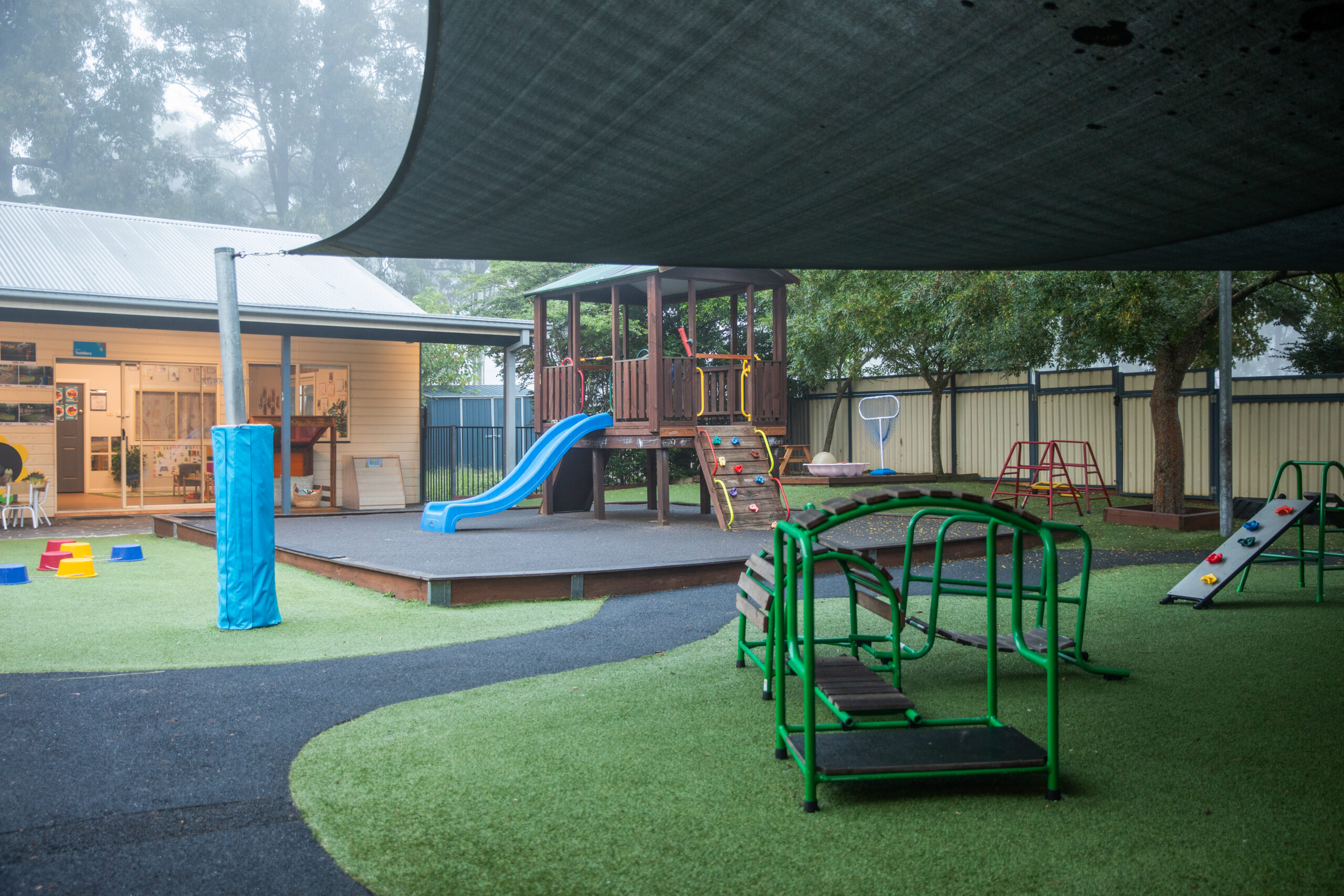

If you've ever winced watching your child scramble to the top of a climbing frame, or held your breath while they negotiated a muddy bank on a bush walk, you're not alone. The instinct to protect is one of the most natural things in the world. But there's a growing body of research, and a strong consensus among early childhood educators, that when it comes to play, some of the most valuable experiences are the ones that involve a little bit of risk. Here's what that actually means, why it matters for your child's development, and how we think about it at Milestones.
What is risky play, exactly?
Risky play doesn't mean dangerous play. The distinction matters. Play Australia's Risky Play Position Statement is clear: risky play is not unsafe play. It may involve some risk of minor injury, but it does not involve hazards that cause serious harm.
In practice, risky play looks like: climbing trees or equipment at height; running, rolling and rough-and-tumble with friends; balancing on logs or uneven surfaces; using tools like sticks, shovels or simple woodworking equipment; exploring near water or in nature; hiding in spaces out of an adult's immediate sightline. The premise is always the same: children are given the opportunity to test their abilities, encounter uncertainty, and learn to assess and manage the challenges in front of them.
What it doesn't look like is chaos. Good risky play is supervised, intentionally designed, and supported by educators who understand when to step back and when to step in.
What the research tells us
The evidence for risky play is substantial and consistent. Research has linked risky play to a wide range of developmental benefits, including risk-assessment skills, increased physical activity and wellbeing, and social competencies and resilience.
One Canadian study measured the effects of encouraging risky play in early learning settings with children aged two to five. Researchers found significant decreases in depressive states, antisocial behaviour, and unsafe physical activity, alongside increases in independent play, play with natural materials, and prosocial behaviours. Educators observed improved socialisation, problem-solving, focus, self-regulation, creativity, and self-confidence, and a reduction in stress, boredom, and injury.
That last point is worth pausing on: well-managed risky play can actually reduce the likelihood of injury, not increase it. Children who are given opportunities to assess and manage risk from an early age are better equipped to manage it as they grow.
Play Australia's Position Statement recognises the particular importance of the first eight years of life for developing risk literacy skills, risk management skills, and a healthy appetite for risk, foundations that carry into adult life.
How risky play connects to the Early Years Learning Framework
Risky play isn't just good practice, it's embedded in Australia's national early learning curriculum. The Early Years Learning Framework (EYLF) directly supports children's engagement with challenge and managed risk. Under Outcome 1, children are encouraged to develop autonomy, resilience and a sense of agency by taking considered risks in their decision-making and learning to cope with the unexpected. Under Outcome 3, children are supported to become strong in their physical learning and mental wellbeing through challenging outdoor environments.
The EYLF calls on educators to create environments that encourage children to explore, solve problems, create and construct. NQS Quality Area 3 reinforces that the physical environment must be safe, suitable and organised to support children's full participation in the programme.
The key word in all of that is balance. Safety and challenge are not opposites, they are complementary, and good early childhood environments hold both.
How risky play connects to the Early Years Learning Framework
Risky play isn't just good practice, it's embedded in Australia's national early learning curriculum. The Early Years Learning Framework (EYLF) directly supports children's engagement with challenge and managed risk. Under Outcome 1, children are encouraged to develop autonomy, resilience and a sense of agency by taking considered risks in their decision-making and learning to cope with the unexpected. Under Outcome 3, children are supported to become strong in their physical learning and mental wellbeing through challenging outdoor environments.
The EYLF calls on educators to create environments that encourage children to explore, solve problems, create and construct. NQS Quality Area 3 reinforces that the physical environment must be safe, suitable and organised to support children's full participation in the programme.
The key word in all of that is balance. Safety and challenge are not opposites, they are complementary, and good early childhood environments hold both.
What outdoor play looks like at Milestones
At Milestones, outdoor time is a genuine part of the learning day, not a break from it. Our outdoor environments are designed to offer children real opportunities to move, explore, take managed risks, and connect with the natural world around them.
Children have access to spaces and materials that invite challenge: climbing structures, loose parts like logs, tyres and crates, digging areas, and natural elements that change with the seasons. Educators are present and attentive, not hovering, but available, and skilled at reading the difference between a child who is thriving in challenge and one who needs support.
We also draw on the Lifelong Learning Curriculum to ensure that outdoor experiences are intentional, not incidental. Nature play, physical challenge, and connection to the outdoor environment are woven into how we plan and programme across all age groups, from babies exploring grass and texture for the first time, to preschoolers negotiating the rules of a complex team game on the oval.
What parents can do at home
You don't need a forest or a purpose-built adventure playground to support risky play. Some of the most valuable experiences are remarkably simple:
- Let them climb - trees, playground equipment, rocks, fences. Stay close, but resist the urge to lift them down the moment it gets tricky.
- Embrace mud and mess - digging, building, getting dirty. The sensory and physical experience of unstructured outdoor play is hard to replicate indoors.
- Give them real tools - age-appropriate gardening tools, hammers, knives for spreading, scissors for cutting. Supervised use of real objects builds confidence and fine motor skills simultaneously.
- Resist the urge to solve it for them - when your child is stuck, frustrated, or working something out, pause before you intervene. The problem-solving process is often the point.
- Go outside in all weathers - a bit of cold, wind, or drizzle is not a reason to stay in. Children who play outdoors in variable conditions develop physical confidence and environmental awareness that fair-weather play simply can't provide.
Trusting children to know their limits
One of the most consistent findings in risky play research is that children are generally quite good at knowing what they can and cannot handle. Children without developmental issues usually have an inbuilt sense of the dangers they can and cannot manage, and in truly hazardous situations, they reach out for help. Our role as educators and parents isn't to remove risk from children's lives, but to create environments where managed risk is possible, supervised wisely, and celebrated as part of growing up. Aussie Childcare Network
At Milestones, we believe children deserve to know the thrill of reaching the top of something that felt hard, the satisfaction of figuring out a balance puzzle with their body, and the quiet confidence that comes from learning, through experience, that they can handle more than they thought.